This is subject to a change if someone catches an error in my math or finds a reason the moons as listed couldn’t keep a stable orbit or life couldn’t be supported with these things.
There are five moons in orbit around the world of Sultan’s Child. None of them are as big as Luna, Earth’s satellite, but together, they can exert rare and powerful tides.
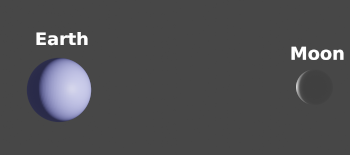
Despite these being multiple moons and appearing in a fantasy novel, they don’t have an over-arching supernatural signifigance. I just thought five moons seemed perfectly likely for a planet roughly Earth-sized.
Kah
Kah is the biggest and slowest of the moons. It’s just over half the mass of Luna and farther away, making it look a little over half as big in the sky.
Unlike Luna there is not a “light side” that people see and a “dark side” that they don’t. Kah turns, showing different parts of its surface. Different parts of its face have nicknames in different cultures, like constellations. So it’s as if, instead of a “man on the moon”, there would be a horse one month, a falcon the next.
The changing faces are because Kah rotates and revolves at different speeds (like most planets but unlike Luna and Mercury). Four of the five moons have shifting faces, but Kah has the most readable surface because of its size. No culture has given names to the faces on the other moons.
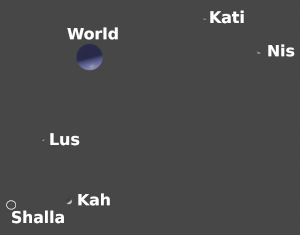
(Shalla is circled because it’s so small and hard to see.)
Nis
Nis is one of two ‘calendar moons’. It revolves every 27 days, and 14 revolutions is one year (378 days in the world of Sultan’s Child). The Haxem and Pahr calendars are based on Nis’s full moons.
Kati
‘Constant Kati’ is the one of the five moons that always shows the same face. It’s rotation and revolution are both 23 days.
Lus
Lus is the other ‘calendar moon’. It revolves every 21 days, and every 18 revolutions makes a year. In the Hundred Princes and the Drylands, calendars are based on Lus.
When Lus and Nis are both full, it is six days before the summer or winter solstice. Both are holidays, called Arrival and Farewell. The holidays are for the solstice, but they’re celebrated at the double full moon.
Shalla
Shalla’s revolves in only seven hours. This means it rises three (and sometimes four) times a day. It rises in the West and sets in the East. It’s just bigger than a point of light, 1/25th the size of the moon, but people can just discern its shape, which is like a potato titled diagonally.
This ‘turned oval’ matches the white mark on the black mare owned by Avan of Precipice, and it’s why she’s named after that moon.
The Great Tide
Once every long while (I’m coming up with 368 years, but I’m not sure that’s right), the four big moons all pull from the same direction. The force is about twice ours. When this happens, there’s a ‘great tide’. Sometimes towns settled close to the sea have to be evacuated until the tide is gone.